
How to Search Civil Dockets
Start at MyCase, Indiana's free Odyssey Public Access search. Both Greene Circuit Court and Greene Superior Court take part. The Case tab fits when you know a cause number or cross reference. Pick the Name tab for a person or business. Use the Attorney tab when counsel is your best clue. Once you choose a Greene court, narrow things by civil category, open or closed status, or a filing-date range. Go easy on filters at first. A transfer or a slightly different name can bury the right result.
Business searches accept the full name. Official search tips also allow a wildcard at the end of a name stem. For a person, enter last name first. Add a first or middle name only as needed. When the assignment is unknown, search both Greene courts. Before trusting any event, confirm the details. Check the cause number, court, case type, filing date, and case style.
- Choose the Case, Name, or Attorney tab.
- Enter the strongest identifier and select a Greene court.
- Use civil type, status, or dates only to narrow a large result set.
- Open the match and read the Chronological Case Summary in order.
- Contact the clerk for an absent filing, official copy, or certification.
Greene Civil Docket Assignment
Greene Circuit and Superior share ordinary civil jurisdiction. A local assignment rule can make one court exclusive. Small claims and evictions belong to Superior alone. Circuit alone handles estates, guardianships, adoptions, and juvenile matters. Civil commitments and ordinary civil cases may land in either court. Odyssey randomly assigns concurrent matters at filing. A related companion filing follows whichever court was selected.
| Matter | Greene court route |
|---|---|
| Small claims and evictions | Superior Court exclusive assignment |
| Estates and guardianships | Circuit Court exclusive assignment |
| Adoption and juvenile matters | Circuit Court, with access limits |
| Ordinary civil and commitments | Concurrent assignment under local rules |
Greene County posts no separate city or municipal civil docket. For a county civil search, stick with the two courts of record and their unified clerk.
What a Greene Civil Docket Shows
The CCS header lists the cause number, court, case type, filing date, and status. The judicial officer appears there too, where available. Party blocks show roles like plaintiff, petitioner, defendant, or respondent, and they may identify counsel. Chronological entries can include the complaint or petition, summons, return of service, and appearance. Later rows may show an answer, motion, notice, order, hearing, judgment, payment, writ, garnishment, satisfaction, and appeal. One caution applies. A docket row and its linked document are not the same thing.
| Cause Number | The Greene court prefix, filing month, civil type, and sequence. |
|---|---|
| Parties | Public party roles and attorney associations, with protected data omitted. |
| Service | Summons, return, and related notice events. |
| Filings | Motions, responses, notices, and orders listed by event date. |
| Outcome | Judgment, agreement, default, dismissal, satisfaction, or appeal activity. |
A motion entry only proves a filing event was recorded. It does not prove the judge granted anything. Look for a later signed order, or ask the clerk for the document itself.
Greene CT Cause Number
An official Court of Appeals record identifies a Greene Superior civil trial cause in the form 28D01-1908-CT-8. It is used here only as a structural example. The prefix 28 means Greene County, D identifies Superior, and 01 is the court sequence. Next, 1908 is the filing year and month, and CT is the displayed civil type. Current uniform numbers normally carry a six-digit final sequence under Indiana Administrative Rule 8.
A civil transfer can change the court identifier. If a full number draws no match, search its core details in the other Greene court. You can also try a party name. Cross references and event entries may reveal the connection. An appellate opinion carries its own appellate cause. Still, it can point to the lower Greene trial cause behind the appeal.
Types of Civil Cases on the Docket
Greene civil court dockets include several paths that do not share identical access or procedure. Ordinary civil disputes may involve contracts, tort claims, property, or other claims. Small claims and eviction causes go to Superior, while estates and guardianships go to Circuit. Adoption and juvenile matters also sit in Circuit, but strong confidentiality rules apply. Civil commitment records can be restricted even though assignment is concurrent.
Remember that a case-type label is just a routing clue. It is not a full account of the claim. Read the initial petition or complaint when it is remotely available. If it is not, the CCS can still identify filing and service events. It does so without exposing the document. Protection-order records follow separate access treatment. They generally do not surface in the ordinary MyCase search.
Greene Civil Filing Channels
Think of the Indiana Electronic Filing System as the submission layer. MyCase is the public viewing layer. Attorneys generally file through a certified electronic filing service provider under Trial Rules 86 and 87. Self-represented litigants face no e-filing requirement. A notice of electronic filing records receipt in that workflow. Even so, public access to the submitted document still depends on court-record rules. The Indiana e-filing overview illustrates the statewide system used for Greene filings.
The statewide filing layer moves documents into the court system. It does not replace a public CCS search or a clerk copy request.
Greene local rules also describe a limited fax filing route, capped at ten pages with a $4 transmission fee per case. That route is separate from IEFS and is not a records-search service. Verify current filing acceptance before sending anything.
Settings and Hearings on Civil Dockets
A civil setting in Greene County can go by many names. Case-management conference. Status conference. Motion hearing, settlement event, bench trial, jury trial, or a term this court prefers. The CCS entry for a setting usually lists the date, time, judicial officer, and location. Treat each setting as one step in the case, not as the promised final trial. A motion and its hearing may even sit on separate rows. A signed order may follow later.
Check for newer entries before trusting any single date. A setting that was continued, reset, or vacated can still sit on the docket looking valid. What controls is the latest signed order plus the current CCS. Greene does not currently appear as a participating county in the live Trial Court Calendars interface. When a civil date seems uncertain, confirm it through MyCase. The clerk or the court office can also confirm it.
Greene E-Filing Availability
The official Indiana e-filing schedule documents availability and implementation across the trial courts.
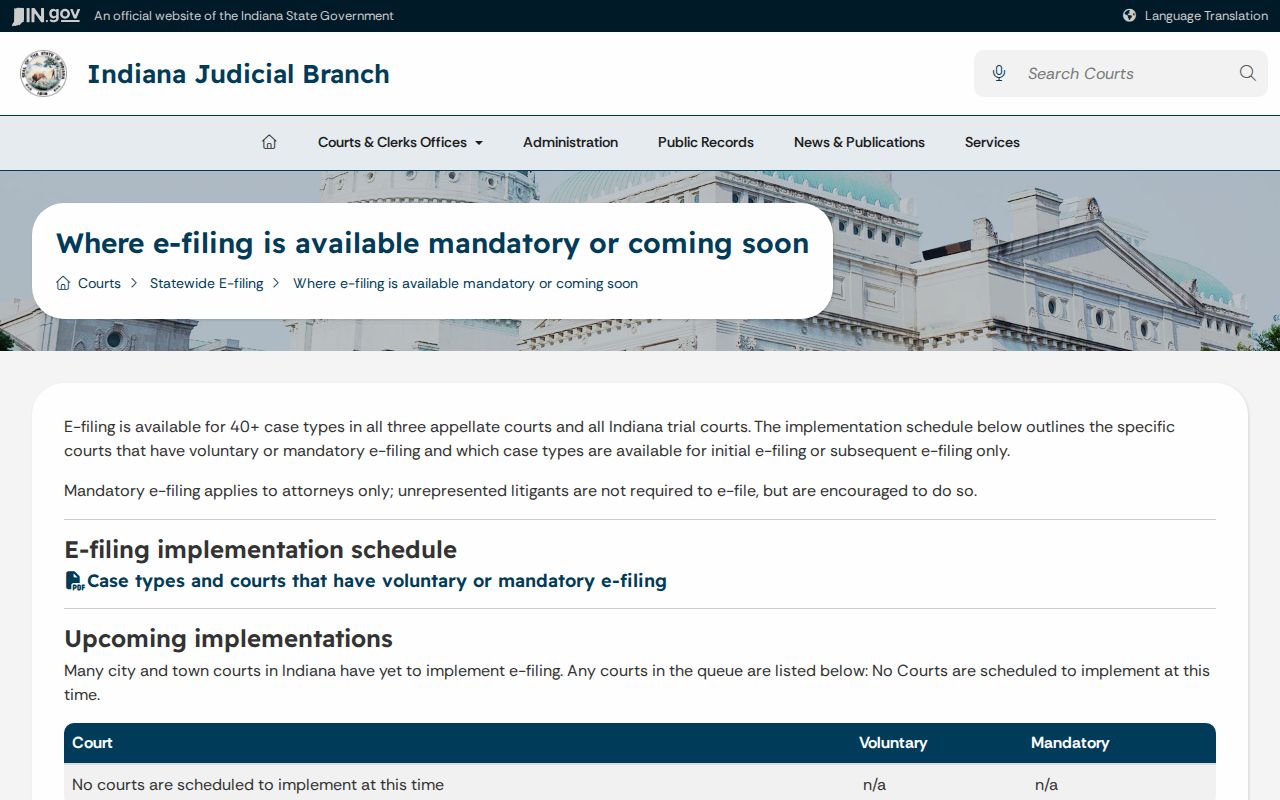
Attorneys in Greene County moved to mandatory electronic filing back in 2017. Today statewide rules govern how cases go in. That gap matters for older files. A paper entry from years past, or a scanned image of it, may not carry the same remote document coverage you get with a current electronic cause.
So when an old judgment or pleading fails to appear online, ask the Greene County Clerk. Ask whether it sits in a paper, bound, microfilm, converted, or scanned collection. The Indiana State Library research holdings can help with historical digging too. For an official copy of anything current, though, the clerk is still the office to ask.
Certified Greene Civil Judgments
A court docket image online is not a certified judgment. To get the real thing, hand the Greene County Clerk of Courts the cause number, the court, the document title, and a rough event date. Copies run $1 per page. Certification adds $3. If you mail the request, leave room in your timeline for locating, review, copying, payment, and return delivery.
Transcripts take a separate path. A word-for-word hearing record comes from the court reporter, not from a clerk's CCS copy. The docket can show that a hearing happened. It cannot reproduce testimony. Keeping the clerk's case file and the reporter's transcript straight routes each request to the office that actually keeps it.
Public Access to Civil Dockets
Indiana court records are presumed open under Administrative Rule 9. Rule 5, statutes, and court orders can limit that access, though. Adoption, juvenile, mental-health, civil-commitment, sealed, and privileged records may be excluded. Protected personal information may be redacted. A case header you can see does not guarantee every filing is open online. For extraordinary exclusion, Rule 6 controls. Rule 9 offers a verified request process for records kept out of view.
A blank result is not a final answer. Check spelling, court, cause-number punctuation, transfer history, date range, and restricted-case rules before asking the clerk whether a public record exists.
You can reach a Greene County civil docket several ways: MyCase, Public Portal access for an entitled party or attorney, the clerk counter, phone at 812-384-8532, or mail to PO Box 229, Bloomfield, IN 47424. A formal county APRA request may work for a county-held record. Court files, though, answer to judiciary rules. Plain clerk copies cost $1 per page, and certification costs $3 each. When you ask for a CCS, order, judgment, or pleading, give enough detail that the clerk can actually find it.